On April 11, eight day before GM reported a first-quarter slump down on the revenue from Chinese market, the Economic Reference in China has published a story called "GM, bright in East instead of West"(in Chinese). Now look back at the story, it looks ironical.
GM China said it earned US$33 million in the latest quarter, down sharply from $162 million a year ago, though the market share grew to 10.4 percent from 9.9 percent last year. It said in the report that the environment in China is more challenging without elaborating. But numbers show that the market is not that profitable as it was last year.
Phil Murtaugh, the Chairman of GM China for more than four years, resigned last month in what is understook to be a disagreement over management strategy. He has been succeeded by Kevin Wale, perviously head of GM's British unit, Vauxhall.
Still a long way to go.
Wednesday, April 20, 2005


Asset_50 billion NPL sold
China Orient Asset Management Corp., one of the country's four major state-owned asset agencies, sold ten packages of nonperforming assets to 19 overseas and local investors, Asian Wall Street Journal reported citing the official Financial News.
The ten packages were part of more than 50 billion yuan, or about US$6 billion, of distressed assets auctioned by China Orient. In March, China Orient's annual report said it would sell the nonperforming assets of 50 billion yuan by the end of the year, getting back 5.5 billion yuan, or about US$600 million, which accounts 11 percent of the total assets.
The 19 investors included foreign investors such as Deutsche Bank AG, German's largest lender, the Credit Suisse First Boston Inc, a unit of Zurich-based Credit Suisse, Switzerland's No.2 bank, J.P. Morgan Chase & Co., U.S's second biggest bank , Hong Kong-based Pacific Alliance Group, Mellon HBV Alliance Group in New York and London, and local investors from Shanghai, Anhui Province, Hubei province.etc. (China daily has mistaken J.P. Morgan with Morgan Stanley in its story) . Details for each investor are not made public.
Non-performing asset has been a barrier for Chinese companies, especially commercial banks, in China's financial reform. In 1999, four asset management, including China Orient, China Huarong Asset Management Inc., China Xinda Asset Management Inc., and China Great Wall Asset Management Inc., were set up to manage the separated nonperforming assets from commercial banks to push banks listed in overseas market.
China Banking Regulatory Commission reported on April 18, a day before China Orient's selling, that four asset management companies has sold nonperforming assets of 688.55 billion yuan, or US$67 billion, accounting for about 20 percent of the total assets, till this March. The assets China Orient sold are 106.7 billion yuan, or 22 percent of the total sold assets, ranked as second among four companies after China Xinda.
The ten packages were part of more than 50 billion yuan, or about US$6 billion, of distressed assets auctioned by China Orient. In March, China Orient's annual report said it would sell the nonperforming assets of 50 billion yuan by the end of the year, getting back 5.5 billion yuan, or about US$600 million, which accounts 11 percent of the total assets.
The 19 investors included foreign investors such as Deutsche Bank AG, German's largest lender, the Credit Suisse First Boston Inc, a unit of Zurich-based Credit Suisse, Switzerland's No.2 bank, J.P. Morgan Chase & Co., U.S's second biggest bank , Hong Kong-based Pacific Alliance Group, Mellon HBV Alliance Group in New York and London, and local investors from Shanghai, Anhui Province, Hubei province.etc. (China daily has mistaken J.P. Morgan with Morgan Stanley in its story) . Details for each investor are not made public.
Non-performing asset has been a barrier for Chinese companies, especially commercial banks, in China's financial reform. In 1999, four asset management, including China Orient, China Huarong Asset Management Inc., China Xinda Asset Management Inc., and China Great Wall Asset Management Inc., were set up to manage the separated nonperforming assets from commercial banks to push banks listed in overseas market.
China Banking Regulatory Commission reported on April 18, a day before China Orient's selling, that four asset management companies has sold nonperforming assets of 688.55 billion yuan, or US$67 billion, accounting for about 20 percent of the total assets, till this March. The assets China Orient sold are 106.7 billion yuan, or 22 percent of the total sold assets, ranked as second among four companies after China Xinda.
Tuesday, April 19, 2005
Gamble_Where you want to gamble, Singapore or Macau or...?
Singapore government said Monday that it would allow two licenses by year end, which needs estimated US$3 billion investment, to build and operate casino resorts and make Singapore a more vibrant place to live and work.
“We cannot stand still. The whole region is on the move,” Lee was quoted by Reuters as saying. “If we don’t change, where will we be in 20 years?”
A website named Casino City has kept a full news list on the process Singapore government made a decision on the gambling legalization. Asian Wall Street said that Singaporeans already spend an estimated S$2 billion, or US$1.2billion, gambling abroad each year including on cruise ships that ply waters just off Singapore, and in Genting Highlands, a casino in Malaysia. Nearly 20 operators, most from Las Vagas, submitted concepts for what Singapore calls an "integrated resort". The new casino resorts will be likely open around 2009.
The reason why giant gambling operators eyeing a Singapore license is that they are not easy to get a license in Macau, the biggest gambling Asian city after Las Vagas in the United States. The government in Macau, the only city in China where gambling is legalised, has already granted three licenses to Macau tycoon Stanley Ho's Las Vegas Sands Corp. , Wynn Resort Ltd and Galaxy Resort & Casino.
One day after the Singapore government legalize the gambling, Galaxy Resort & Casino, one of the three casino operators in Macau, will be sold to the Hong Kong listed company-K. Wah Construction Materials Ltd. for HK$18.4 billion ($2.4 billion) . Both companies are owned by Hong Kong tycoon Lui Che-woo. Galaxy is likely to be the first traded gambling company in Hong Kong.
Lui's family ``needs the money to build their two planned casino resorts,'' said Karen Tang, a Hong Kong-based analyst at Deutsche Securities Asia Ltd, quoted from Bloomberg ``They are using the stock exchange to do that.'' Now, it needs to compete with Singapore, too.
Officials in Hong Kong, the competing city with Singapore in tourism and finance, said on radio that they will not open the door to the gaming industry though Sinapore did that.
The prime minister in Singapore said tourists now stay only for three days in the city, one day less compared with they stay in Hong Kong.
A Chinese friend who first went to Singapore last month told me that Singapore is comfortable with most people speaking Mandarin. "But compared with Hong Kong, it is boring to see so many building with same height, and the newspapers there are not that interesting, too." She said.
“We cannot stand still. The whole region is on the move,” Lee was quoted by Reuters as saying. “If we don’t change, where will we be in 20 years?”
A website named Casino City has kept a full news list on the process Singapore government made a decision on the gambling legalization. Asian Wall Street said that Singaporeans already spend an estimated S$2 billion, or US$1.2billion, gambling abroad each year including on cruise ships that ply waters just off Singapore, and in Genting Highlands, a casino in Malaysia. Nearly 20 operators, most from Las Vagas, submitted concepts for what Singapore calls an "integrated resort". The new casino resorts will be likely open around 2009.
The reason why giant gambling operators eyeing a Singapore license is that they are not easy to get a license in Macau, the biggest gambling Asian city after Las Vagas in the United States. The government in Macau, the only city in China where gambling is legalised, has already granted three licenses to Macau tycoon Stanley Ho's Las Vegas Sands Corp. , Wynn Resort Ltd and Galaxy Resort & Casino.
One day after the Singapore government legalize the gambling, Galaxy Resort & Casino, one of the three casino operators in Macau, will be sold to the Hong Kong listed company-K. Wah Construction Materials Ltd. for HK$18.4 billion ($2.4 billion) . Both companies are owned by Hong Kong tycoon Lui Che-woo. Galaxy is likely to be the first traded gambling company in Hong Kong.
Lui's family ``needs the money to build their two planned casino resorts,'' said Karen Tang, a Hong Kong-based analyst at Deutsche Securities Asia Ltd, quoted from Bloomberg ``They are using the stock exchange to do that.'' Now, it needs to compete with Singapore, too.
Officials in Hong Kong, the competing city with Singapore in tourism and finance, said on radio that they will not open the door to the gaming industry though Sinapore did that.
The prime minister in Singapore said tourists now stay only for three days in the city, one day less compared with they stay in Hong Kong.
A Chinese friend who first went to Singapore last month told me that Singapore is comfortable with most people speaking Mandarin. "But compared with Hong Kong, it is boring to see so many building with same height, and the newspapers there are not that interesting, too." She said.
Opinion_Other bloggers' opinion
blogger friend Andrea did a story on the protesting with a deeper view than mine. At the same time, I want to know how many percent of the protestors are college students.
Opinion_review comments from dear readers
Internet is good to me, especially when almost a dozen people were willing to share their opinions with me openly on the topic of Japan-China relations. Thanks for you all.
I talked about Patriotism in China in my story, but the point was disagreed by many readers such as Dave, Joann, Shulan and one or two annoymous people. I agree with Shulan that "Patriotism also is a mighty political weapon " in the perspective of politics, but my point is in the view of common people.
When People's Republic of China was firstly set up in 1949, people believed that China will finally develop into a Communism society, where all people could live a happy life with average living necessaries; Then in 1950s, people lived a hard life caused by natural disasters. Some people even starved to death, though they still held firm belief; In 1960s, when everything was about going back to normal, Cultural Revolution came. People's feelings and belief were strongly hurt, while some of them expected the Spring coming soon; Ten years later, the disaster went away. Chinese people found that they have lost so many time on the political fighting that the economies in other countries such as US and Japan have already been quite stronger. Some leaders created policies to push the nation's economy, though most of the policies are hard to implement under the heavy political pressure. People's belief was wandering between Communism and Capitalism, while the youngers such as students began to suspect. After 1989, government solidened its power, while different beliefs among the people were totally beaten. Fortunately, economic reform has attracted people's attention, with some extremists saying "Money is everything". Until now, I would like to say only patriotism remains under these years. That's good, in some extent, that something is unchanged
I could agree with Dave many people did wrong in the cultural revolution, but it is a quite different era when everyone talks about politics. 無塵工作室(the dustless workshop) is right saying that most Chinese don't really care much about politics at this time because they firstly want a better life. In the cultural revolution, hope everyone knows, all the living necessaries are from the government, and totally free to every people, which I think is amazing for a start-up government to achieve. But now things are different. Being Poor and rich depend on your effort, and no government, including China and other countries such as US, will promise that to their people. Dave is afraid that Chinese people will do the same thing as their parents or grandparents did in the Cultural Revolution, but come on, they are under totally social contexts.
One thing is dangerous, I believe, is the point from an annoymous reader saying that "Wake up, China" or "help the people of China" in the comments. I am sorry but I couldn't quite understand your point because it seems like Chinese people were now living a bad life. You could say the same words to some others, like those people in South Asia who suffered from Tsunami, and then they of course, will say thanks to you. You could try, one day, to tell some Chineses living in the nation or overseas that "I am here to help you", and to see their response. Remember to update me because I am curious to know the results, too. Thanks.
One thing I would like to say is that I am sorry to those Japanese suffered in the protesting. I appologize for those violence happening in the protesting, especially if some Japanese are hurt in those cities. Peaceful protesting is acceptable, but violence isn't tolerated.
I talked about Patriotism in China in my story, but the point was disagreed by many readers such as Dave, Joann, Shulan and one or two annoymous people. I agree with Shulan that "Patriotism also is a mighty political weapon " in the perspective of politics, but my point is in the view of common people.
When People's Republic of China was firstly set up in 1949, people believed that China will finally develop into a Communism society, where all people could live a happy life with average living necessaries; Then in 1950s, people lived a hard life caused by natural disasters. Some people even starved to death, though they still held firm belief; In 1960s, when everything was about going back to normal, Cultural Revolution came. People's feelings and belief were strongly hurt, while some of them expected the Spring coming soon; Ten years later, the disaster went away. Chinese people found that they have lost so many time on the political fighting that the economies in other countries such as US and Japan have already been quite stronger. Some leaders created policies to push the nation's economy, though most of the policies are hard to implement under the heavy political pressure. People's belief was wandering between Communism and Capitalism, while the youngers such as students began to suspect. After 1989, government solidened its power, while different beliefs among the people were totally beaten. Fortunately, economic reform has attracted people's attention, with some extremists saying "Money is everything". Until now, I would like to say only patriotism remains under these years. That's good, in some extent, that something is unchanged
I could agree with Dave many people did wrong in the cultural revolution, but it is a quite different era when everyone talks about politics. 無塵工作室(the dustless workshop) is right saying that most Chinese don't really care much about politics at this time because they firstly want a better life. In the cultural revolution, hope everyone knows, all the living necessaries are from the government, and totally free to every people, which I think is amazing for a start-up government to achieve. But now things are different. Being Poor and rich depend on your effort, and no government, including China and other countries such as US, will promise that to their people. Dave is afraid that Chinese people will do the same thing as their parents or grandparents did in the Cultural Revolution, but come on, they are under totally social contexts.
One thing is dangerous, I believe, is the point from an annoymous reader saying that "Wake up, China" or "help the people of China" in the comments. I am sorry but I couldn't quite understand your point because it seems like Chinese people were now living a bad life. You could say the same words to some others, like those people in South Asia who suffered from Tsunami, and then they of course, will say thanks to you. You could try, one day, to tell some Chineses living in the nation or overseas that "I am here to help you", and to see their response. Remember to update me because I am curious to know the results, too. Thanks.
One thing I would like to say is that I am sorry to those Japanese suffered in the protesting. I appologize for those violence happening in the protesting, especially if some Japanese are hurt in those cities. Peaceful protesting is acceptable, but violence isn't tolerated.
Monday, April 18, 2005
Media_Caijing, business magazine for politics?
New York Times did a good story on Hu Shuli, the editor of Caijing Magazine, a popular weekly magazine in China.
Quote:
"Caijing has a good reputation pushing the borders," says Perry Link, a professor of East Asian Studies at Princeton University who has written about the Chinese news media. "But they have to be careful. They may have flexibility, but it's flexibility with a leash."
One of my friends, who is close to Hu, told me that Hu and her Caijing are writing business stories to affect politics. And I couldn't agree more.
Quote:
"Caijing has a good reputation pushing the borders," says Perry Link, a professor of East Asian Studies at Princeton University who has written about the Chinese news media. "But they have to be careful. They may have flexibility, but it's flexibility with a leash."
One of my friends, who is close to Hu, told me that Hu and her Caijing are writing business stories to affect politics. And I couldn't agree more.
Sunday, April 17, 2005
Opinion_What are revised in the New History Book?
In a class, a professor asked the journalism-in-training students: Have you had a clear idea about what are revised in the New History Textbook which is approved by the Ministry of Education in Japan in April? Or have you read that in the newspaper?
Most of the answers are "no" or "not yet". Why? Isn't newspaper or other media good at comparision between the original one(in fact, it is a draft) and rivised one? Why not this time?
Because most reporters couldn't read Japanese? or they assume the readers have already known the materials? or they are too lazy?
After some research on the topic, it is true that not much comparision or even provision of the words from the textbook is provided. Here is some excerpts from a Japanese website. Hope could make myself clear first before talking about it.
124 descriptions of the draft are revised this time, in line with instructions by the government's Textbook Authorization Research Council's. The number of revisions in 2001 was 137. (The revisions on the history textbook is conducted per four year)
five of those Revisions( I will try to find more):
(1) a side-note referring to the 1937 Nanjing Massacre that stated it as a fact, but only as an "incident."
(2) Draft: " the Tokyo Tribunal recognized the Imperial Japanese Army killed a great number of Chinese people."
Revised version:" . . . a great number of Chinese soldiers and civilians were killed and wounded by the Imperial Japanese Army."
(3) History textbooks no longer mention ianfu (comfort women) -- a controversial term that refers to women who were forced to provide sex for Japanese soldiers during World War II. Some texts use roundabout expressions, such as "those who were sent to comfort facilities."
(4) Draft: Japan has been involved in a dispute with China and Taiwan over the ownership of the Japan-controlled Senkaku islets in the East China Sea, known as Diaoyu in China, and with Seoul over Takeshima, a group of South Korea-controlled islets in the Sea of Japan known as Tok-do in South Korea.
Revised version: although the two disputed islands belong to Japan, China has insisted that it owns Senkaku and South Korea is "illegally occupying" Takeshima.
(5) Koreans who were "forced" ( 'kyousei renkou' ) to work in Japan during the war are changed to they were "brought to Japan."
Source:
http://www.japantimes.co.jp/cgi-bin/getarticle.pl5?nn20050406a1.htm(in English)
http://www.japantimes.co.jp/cgi-bin/geted.pl5?ed20050409a1.htm(in English)
http://www.japanresearch.org.tw/china/scholar-43.asp(in Chinese, a brief introuduction about the history textbook controversial since the end of the WWII)
Most of the answers are "no" or "not yet". Why? Isn't newspaper or other media good at comparision between the original one(in fact, it is a draft) and rivised one? Why not this time?
Because most reporters couldn't read Japanese? or they assume the readers have already known the materials? or they are too lazy?
After some research on the topic, it is true that not much comparision or even provision of the words from the textbook is provided. Here is some excerpts from a Japanese website. Hope could make myself clear first before talking about it.
124 descriptions of the draft are revised this time, in line with instructions by the government's Textbook Authorization Research Council's. The number of revisions in 2001 was 137. (The revisions on the history textbook is conducted per four year)
five of those Revisions( I will try to find more):
(1) a side-note referring to the 1937 Nanjing Massacre that stated it as a fact, but only as an "incident."
(2) Draft: " the Tokyo Tribunal recognized the Imperial Japanese Army killed a great number of Chinese people."
Revised version:" . . . a great number of Chinese soldiers and civilians were killed and wounded by the Imperial Japanese Army."
(3) History textbooks no longer mention ianfu (comfort women) -- a controversial term that refers to women who were forced to provide sex for Japanese soldiers during World War II. Some texts use roundabout expressions, such as "those who were sent to comfort facilities."
(4) Draft: Japan has been involved in a dispute with China and Taiwan over the ownership of the Japan-controlled Senkaku islets in the East China Sea, known as Diaoyu in China, and with Seoul over Takeshima, a group of South Korea-controlled islets in the Sea of Japan known as Tok-do in South Korea.
Revised version: although the two disputed islands belong to Japan, China has insisted that it owns Senkaku and South Korea is "illegally occupying" Takeshima.
(5) Koreans who were "forced" ( 'kyousei renkou' ) to work in Japan during the war are changed to they were "brought to Japan."
Source:
http://www.japantimes.co.jp/cgi-bin/getarticle.pl5?nn20050406a1.htm(in English)
http://www.japantimes.co.jp/cgi-bin/geted.pl5?ed20050409a1.htm(in English)
http://www.japanresearch.org.tw/china/scholar-43.asp(in Chinese, a brief introuduction about the history textbook controversial since the end of the WWII)
Thursday, April 14, 2005
Fashion_the dresses are still good
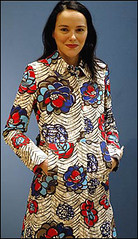
Having said that, the Cacharel( shoot by Valerio Mezzanotti) dress on The New York Times is still good, while Hollywood movies are not bad, too.
Opinion_Japan and China, who is the victim?
An open letter about the relation between Japan and China has iginited great response in all of my classmates in Hong Kong. Only another girl and me, who are from mainland, were involved in the bunch of back-and-forth emails, with other talkers from different countries including U.S., Canada and Hong Kong. That girl showed in the email her great discontent to the people who argued with only limited knowledge about the history of Japan and China, and I tried to be "neutral" in my email to balance the two. Then I found nobody really understand, or talk about the emails we both wrote. Then I became muted, that girl never responsed, and all the other mainland girls kept silenced, too. Is that because Chinese always respect other's arguments, and most of them will keep silent if they don't agree with others?
If I explain it as the cultural difference in the arguments on the relation between Japan and China, it will look like silly because we are already in a era called globalization. But not many people try to understand the difference, either in the culture or government behavior, because the people are educated so differently. The newspaper and other media I see here is totally, or mostly, different from ones I read in the mainland, though they are both useful. I will not try to point out which is right or which is wrong, because there is not a universal standard.
I once heard one of my foreign friends said that "Patriotism is the worst thing for the Chinese". Yes, to the other countries, especially the not-that-friendly ones such as U.S., they will hate that because it means the people always support their countries, or the Chinese governments, in some extent. But to China, it may be a better thing because people will have nothing to believe if they lose patriotism. The dangerous thing is that China will collapse if people have nothing to believe, and how about the money of those foreign investors' money?
I would like to say I keep a open mind to what people say about Chinese and Japanese. And I will keep the good habit, too. But should I keep silent all the time, or say it though others may not respect or even read?
If I explain it as the cultural difference in the arguments on the relation between Japan and China, it will look like silly because we are already in a era called globalization. But not many people try to understand the difference, either in the culture or government behavior, because the people are educated so differently. The newspaper and other media I see here is totally, or mostly, different from ones I read in the mainland, though they are both useful. I will not try to point out which is right or which is wrong, because there is not a universal standard.
I once heard one of my foreign friends said that "Patriotism is the worst thing for the Chinese". Yes, to the other countries, especially the not-that-friendly ones such as U.S., they will hate that because it means the people always support their countries, or the Chinese governments, in some extent. But to China, it may be a better thing because people will have nothing to believe if they lose patriotism. The dangerous thing is that China will collapse if people have nothing to believe, and how about the money of those foreign investors' money?
I would like to say I keep a open mind to what people say about Chinese and Japanese. And I will keep the good habit, too. But should I keep silent all the time, or say it though others may not respect or even read?
Bank_Financial Planner, everyone's need?
"Hong much money do you need for the remaining life before you retired?" A question came from one of the financial advisors in a seminar. It should be about three million HK dollars to maintain a decent life, but you need at least nine million taking the inflation into consideration, he said.
That's you will hear if you have a personal financial planner. He will help you get a steady return on your savings with investing into different financial products. He will also prepare you for the number of money planning for the certain periods. A professional word for the service is "Wealth management".
The best companies in wealth management is from Swizterland, such as UBS, according to one of my business professors. Many small companies begin to fill the gap between individual customers and investment banks. B M Intelligence in Hong Kong, who is listed on the growth enterprise market, is one of the examples, who helps the individuals find the right financial products, from various investoment banks.
BM's advantage should be their small size with the turnover of about 9 million HK dollars in the last fiscal nine months, so that it could be quite flexible. But how it will compete with giant investment banks is a question because the sales department in those banks are always more aggressive. BM could focus more on the individual customers, which may not attract those sales people in the banks, though it is less profitable.
The money they offer is not that attractable, with only about 14,000 HK dollars for a financial planner and 8,000 for a planner trainee. With those money, how to maintain a decent life for themselves?
That's you will hear if you have a personal financial planner. He will help you get a steady return on your savings with investing into different financial products. He will also prepare you for the number of money planning for the certain periods. A professional word for the service is "Wealth management".
The best companies in wealth management is from Swizterland, such as UBS, according to one of my business professors. Many small companies begin to fill the gap between individual customers and investment banks. B M Intelligence in Hong Kong, who is listed on the growth enterprise market, is one of the examples, who helps the individuals find the right financial products, from various investoment banks.
BM's advantage should be their small size with the turnover of about 9 million HK dollars in the last fiscal nine months, so that it could be quite flexible. But how it will compete with giant investment banks is a question because the sales department in those banks are always more aggressive. BM could focus more on the individual customers, which may not attract those sales people in the banks, though it is less profitable.
The money they offer is not that attractable, with only about 14,000 HK dollars for a financial planner and 8,000 for a planner trainee. With those money, how to maintain a decent life for themselves?
Wednesday, April 13, 2005
zhangziyi
A radio program in Hong Kong:
Anchor A:
Have you heard of 26-year-old Zhang ziyi, who starred in the Crouching Dragon Hidden Tiger, been named as one of the most 100 influential people in 2005 by Time Magazine?
Anchor B:
Yes, unbelievable. Who is influnced by her?
That's the typical criticism to Zhang by the media in Hong Kong, also in China. But they have to admit, the young former dancer has been promoted to the internation limelight in the few years, without any famous family background.
She may not be admired by the people, but she shows to people, both like her or not, that a Chinese girl could do the things she wants with her efforts and hard work. That should be called "influnce", isn't it?
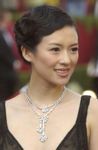
Anchor A:
Have you heard of 26-year-old Zhang ziyi, who starred in the Crouching Dragon Hidden Tiger, been named as one of the most 100 influential people in 2005 by Time Magazine?
Anchor B:
Yes, unbelievable. Who is influnced by her?
That's the typical criticism to Zhang by the media in Hong Kong, also in China. But they have to admit, the young former dancer has been promoted to the internation limelight in the few years, without any famous family background.
She may not be admired by the people, but she shows to people, both like her or not, that a Chinese girl could do the things she wants with her efforts and hard work. That should be called "influnce", isn't it?
Telecom_NBA cooperate with China Mobile
National Basketball Association, the biggest U.S.
basketball association, has cooperated with China Mobile, the biggest telecom company by users, on the content of its data service.
The M-zone service, a content package for mobile phones targeting to teen and young adult, will be promoted with the NBA game scores,statistics and downloads of NBA logos and player images.
As a typical cooperation contract, not specified period of the cooperation or the terms is referred in the press release. I could only find it is a "multi-year" agreement.
Anyway, not bad.


basketball association, has cooperated with China Mobile, the biggest telecom company by users, on the content of its data service.
The M-zone service, a content package for mobile phones targeting to teen and young adult, will be promoted with the NBA game scores,statistics and downloads of NBA logos and player images.
As a typical cooperation contract, not specified period of the cooperation or the terms is referred in the press release. I could only find it is a "multi-year" agreement.
Anyway, not bad.
Saturday, April 09, 2005
Bank_Fund banks start in China
Chinese Central Bank said Wednesday that it will allow Industrial & Commercial Bank of China, China Construction Bank and Bank of Communications to be the first lender to set up fund management companies in China, reported Bloomberg.
Two of the three banks, ICBC and Bank of Communications planed to set up joint venture with foreign firms, the China Securities Journal reported citied annoymous sources(in Chinese) on Thursday.
Bank of Communications plans to set up a fund operations with HSBC holding and Pacific Issurance company. ICBC plans to partner with Credit Suisse First Boston Corp. (CSF.YY) and China Ocean Shipping (Group) Co. to establish fund operations, the newspaper said. Bank of Construction has not confirmed the name of the cooperator though it confirmed there will be a foreign strategic investor, the newspaper added.
The regulators, including China' Central Bank, the China Banking Regulatory Commission, and the China Securities Regulator Commission, will grant the approval to the first fund management company by September.
But the lack of related law in China is a problem for the regulators to monitor the operation of those fund management companies set up by banks. The firewall between the daily deposit service and the securities investment has yet to set up. Chen Xiaoyun, the law official in the Central bank, said that the law to regulate the securities investment in the commecial banks are under construction, without giving the schedule, reported Sina.
U.S. met the same questions in 1930s, when the Bank of Act 1933 was introduced to limit commercial banks. Banks could receive no more than 10 per cent of their income from their income from the securities market, a limit so small that many abandoned their business on Wall Street, reported New York Times in 1998. Bank Holding Company Act of 1956 also places restrictions on what bank can do in the insurance businesses.
With the recent bribe scandal in the state-owned banks, investors should expect stronger regulations from the nation, besides internal auditing in banks themselves.
Two of the three banks, ICBC and Bank of Communications planed to set up joint venture with foreign firms, the China Securities Journal reported citied annoymous sources(in Chinese) on Thursday.
Bank of Communications plans to set up a fund operations with HSBC holding and Pacific Issurance company. ICBC plans to partner with Credit Suisse First Boston Corp. (CSF.YY) and China Ocean Shipping (Group) Co. to establish fund operations, the newspaper said. Bank of Construction has not confirmed the name of the cooperator though it confirmed there will be a foreign strategic investor, the newspaper added.
The regulators, including China' Central Bank, the China Banking Regulatory Commission, and the China Securities Regulator Commission, will grant the approval to the first fund management company by September.
But the lack of related law in China is a problem for the regulators to monitor the operation of those fund management companies set up by banks. The firewall between the daily deposit service and the securities investment has yet to set up. Chen Xiaoyun, the law official in the Central bank, said that the law to regulate the securities investment in the commecial banks are under construction, without giving the schedule, reported Sina.
U.S. met the same questions in 1930s, when the Bank of Act 1933 was introduced to limit commercial banks. Banks could receive no more than 10 per cent of their income from their income from the securities market, a limit so small that many abandoned their business on Wall Street, reported New York Times in 1998. Bank Holding Company Act of 1956 also places restrictions on what bank can do in the insurance businesses.
With the recent bribe scandal in the state-owned banks, investors should expect stronger regulations from the nation, besides internal auditing in banks themselves.
Bank_Japanese Nomura to expand in China
Nomura Holdings Inc.,
Also reported by Sina(in Chinese).
Tokyo-based Nomura, which isn't allowed to own more than a third of a securities firm under Chinese regulations, plans to set up a company in
The plan went after its
"Nomura needs to build its relationships with Chinese officials to overcome obstacles and win business," Yoji Takeda, who helps managing $250million as Head of Asia Equities at RBC Investment Management (Asia) Ltd. in Hong Kong, China daily reported in Jan. 2005.
In January, Nomura announced that it would expand its investment banking services in
Morgan Stanley has owned one third of China International Capital Corp., the biggest investment bank, since 1995. Goldman, received regulatory approval Dec. 2 to establish an investment-banking venture in
Nomura has recently named Yugo Ishida as its new Chief Executive of its International branch. in April 1.
Thursday, April 07, 2005
Company_Take care of your emails
Morgan Stanley, which today began battling a $2.7 billion lawsuit by financier Ron Perelman, said the U.S. Securities and Exchange Commission may accuse the company for failing to retain e-mails, reported Bloomberg.
SEC said that Morgan Stanley, the world's No.2 securities firm, has deliberately recycled the emails recordings in the backup tapes. The company's lawyers ``knew as of June 7, 2004, that nearly a third of the restored backup tapes did not contain e-mail, implying that they may have been recycled in violation'' of the SEC's 2002 order, Elizabeth Maass, the judge in the Perelman litigation said in the ruling. SEC wanted to find the evidence from those tapes if Morgan Stanley knew the accounting fraud at Sunbeam Corp., a Morgan Stanley client.
Almost a month ago, Harry Stonecipher, Boeing Chief Excutive, was fired by the board after one of his embarrassing emails with a senior woman executive was exposed to the board by an annoymous employee. Stonecipher has married with two adult children, according to the Guardian.
The emails inside Boeing are monitored by a program, which could make security personnel keep tabs on every employee's email messages, according to the report from International Labor Communications Association. The employees has to be careful in writing an email, or it will help ending the job. "What you say, wear, or maybe even think, and whom you choose to hang with, can mean the end of job or career. " The report said.
Not only employees, but also employers should be careful, too. So does Morgan Stanley. The regulators may force the company to provide the email recordings when they think it is possible. But at the same time, it is everyone's privacy that will be recorded in the tapes and exposed to the public.
At last, I began to wonder about the email providers such as Yahoo and Google. If , someone wants to check a suspected person's email content one day, will the companies do that?
SEC said that Morgan Stanley, the world's No.2 securities firm, has deliberately recycled the emails recordings in the backup tapes. The company's lawyers ``knew as of June 7, 2004, that nearly a third of the restored backup tapes did not contain e-mail, implying that they may have been recycled in violation'' of the SEC's 2002 order, Elizabeth Maass, the judge in the Perelman litigation said in the ruling. SEC wanted to find the evidence from those tapes if Morgan Stanley knew the accounting fraud at Sunbeam Corp., a Morgan Stanley client.
Almost a month ago, Harry Stonecipher, Boeing Chief Excutive, was fired by the board after one of his embarrassing emails with a senior woman executive was exposed to the board by an annoymous employee. Stonecipher has married with two adult children, according to the Guardian.
The emails inside Boeing are monitored by a program, which could make security personnel keep tabs on every employee's email messages, according to the report from International Labor Communications Association. The employees has to be careful in writing an email, or it will help ending the job. "What you say, wear, or maybe even think, and whom you choose to hang with, can mean the end of job or career. " The report said.
Not only employees, but also employers should be careful, too. So does Morgan Stanley. The regulators may force the company to provide the email recordings when they think it is possible. But at the same time, it is everyone's privacy that will be recorded in the tapes and exposed to the public.
At last, I began to wonder about the email providers such as Yahoo and Google. If , someone wants to check a suspected person's email content one day, will the companies do that?
Wednesday, April 06, 2005
Banking_Morgan Stanley kick off the credit card business
Morgan Stanley said it is looking to spin off Discover credit-card unit, one of the several steps to quell the turmoil around CEO Philip Purcell's leadership of the investment firm, Wall Street Journal reported.
By giving the Discover unit to shareholders, Purcell would exit a business that generated 19 percent of last year's pretax profit, or $1.27 billion. Morgan Stanley, which decided to pursue a spinoff after former executives demanded Purcell's ouster, will be left with a smaller balance sheet and businesses more vulnerable to the ups and downs of stock and bond markets, Bloomberg reported after the interviews with some analysts.
Also, by giving the Discover unit to shareholders instead of selling outside will avoid the tax based on the Discover's total market value. Discover is the seventh-largest credit-card issuer, with more than 50 million cardholders. It is estimated that the Discover unit may be worth as much as $14 billion as a standalone company, said David Trone, an analyst at Fox-Pitt, Kelton.
Morgan Stanley doesn't give up credit-card business though it said it will spin off the Discover unit. It has opened a new website in United Kingdoms to advertise for its three credit cards named with Morgan Stanley.
"Each business - - securities and payments - - is exceptionally well positioned in its respective marketplaces, with world-class brands, strong momentum and significant growth opportunities." said Philip J. Purcell, Morgan Stanley's chairman and chief executive officer.
Does it mean Discover cards in U.S. is not world-class brand, but Morgan Stanley credit card in U.K. is?
By giving the Discover unit to shareholders, Purcell would exit a business that generated 19 percent of last year's pretax profit, or $1.27 billion. Morgan Stanley, which decided to pursue a spinoff after former executives demanded Purcell's ouster, will be left with a smaller balance sheet and businesses more vulnerable to the ups and downs of stock and bond markets, Bloomberg reported after the interviews with some analysts.
Also, by giving the Discover unit to shareholders instead of selling outside will avoid the tax based on the Discover's total market value. Discover is the seventh-largest credit-card issuer, with more than 50 million cardholders. It is estimated that the Discover unit may be worth as much as $14 billion as a standalone company, said David Trone, an analyst at Fox-Pitt, Kelton.
Morgan Stanley doesn't give up credit-card business though it said it will spin off the Discover unit. It has opened a new website in United Kingdoms to advertise for its three credit cards named with Morgan Stanley.
"Each business - - securities and payments - - is exceptionally well positioned in its respective marketplaces, with world-class brands, strong momentum and significant growth opportunities." said Philip J. Purcell, Morgan Stanley's chairman and chief executive officer.
Does it mean Discover cards in U.S. is not world-class brand, but Morgan Stanley credit card in U.K. is?
Tuesday, April 05, 2005
Society_be good to animals
The fur of raccon dogs are separated with knifes when animals are still alive. The scene happened in one of the villages in Hebei province in China, reported Sina.
Those animals should hate humans forever though they are dead. Pity them.
It made me think of some Chinese's extreme actions towards Japan's possible election to U.N. counsel. It is already a new era when the relations between China and Japan has changed a lot from dozens years ago. Chinese should be view the development in a new way. But to those victims who suffered from the war, they may never forget the day when they were treated as those raccon dogs.
"Do not do things that you don't want others to do". An old Chinese saying said. Please remember, those crude people who treated animals badly, and those who never committed they have done that.
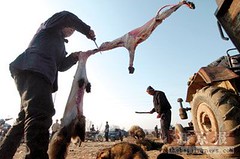

Those animals should hate humans forever though they are dead. Pity them.
It made me think of some Chinese's extreme actions towards Japan's possible election to U.N. counsel. It is already a new era when the relations between China and Japan has changed a lot from dozens years ago. Chinese should be view the development in a new way. But to those victims who suffered from the war, they may never forget the day when they were treated as those raccon dogs.
"Do not do things that you don't want others to do". An old Chinese saying said. Please remember, those crude people who treated animals badly, and those who never committed they have done that.
Monday, April 04, 2005
Media_Is a Fox business news channel possible?
Fox News is now wandering if it will launch a business news channel, while its CEO Roger Alies said he is still learning who the viewer would be, reported Reuters.
Will fox succeed CNBC and Bloomberg to be the most popular business news channel? Hmmm, Rupert Murdoch has to work it out.
Will fox succeed CNBC and Bloomberg to be the most popular business news channel? Hmmm, Rupert Murdoch has to work it out.
Blog_bloggers in Hong Kong
Hong Kong based Standard did a good job in a story introducing the bloggers in Hong Kong. As a contributor to one of the blogging websites Chattergarden, I know it is hard to be a blogger in Hong Kong, especially in politics. People prefer to listening instead of speaking themselves.
Someone said: The measurement of success in Hong Kong is money instead of others. Of course, blogging couldn't make a big money at this time.
I met an experienced reporter from China's newsweek today. We talked a bit about the media in China. His opinion on blog in China is quite interesting.
"I believe blog will act as only one of the news sources for the news aggregator. " He said.
That's totally not what I learned from my classes.
Someone said: The measurement of success in Hong Kong is money instead of others. Of course, blogging couldn't make a big money at this time.
I met an experienced reporter from China's newsweek today. We talked a bit about the media in China. His opinion on blog in China is quite interesting.
"I believe blog will act as only one of the news sources for the news aggregator. " He said.
That's totally not what I learned from my classes.
Friday, April 01, 2005
Economy_Japan, optimists outnumber pessimists
The biggest drop in confidence among Japan's large manufacturers since September 2001 reflected concern a recovery in the world's second-largest economy is faltering.
The confidence index for large manufactures fell to 14 points in March from 22 in December and a 13-year high of 26 in September, the Bank of Japan's quarterly Tankan business-sentiment survey showed yesterday.
The drop adds to signs that a recovery from recession has stalled, after reports this week showed falling factory production and household spending. Higher prices of oil, plastics and metals are curbing profits at companies including Matsushita Electric Industrial Co., leaving them less money to hire workers and buy machines, reported Bloomberg.
"Japan is struggling in the balance sheet recession period, and the government has depended on fiscal policy to maintain demand". Richard Koo, the Chief Economist at Nomura Research Institute in a seminar yesterday.
Koo said that Japanese companies are injecting the cash flow from China's business to pay down the debt on their balance sheets, which helps reducing the domestic demand in Japan. "The government had to lend a lot from the banks to make the economy boosted." He added.
The confidence index among mid-sized and small manafactures each fell 5 points to 6 and 0 from last December, while the confidence among large non-manufactures was unchanged at 11 points.
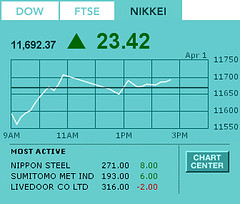
Japan's NIKKEI average rose 122.83, or 1.09 per cent, to 11692.37 at 14:02 pm in Tokyo. Does it mean optimists still outnumber pessimists on Japan's Economy?
The confidence index for large manufactures fell to 14 points in March from 22 in December and a 13-year high of 26 in September, the Bank of Japan's quarterly Tankan business-sentiment survey showed yesterday.
The drop adds to signs that a recovery from recession has stalled, after reports this week showed falling factory production and household spending. Higher prices of oil, plastics and metals are curbing profits at companies including Matsushita Electric Industrial Co., leaving them less money to hire workers and buy machines, reported Bloomberg.
"Japan is struggling in the balance sheet recession period, and the government has depended on fiscal policy to maintain demand". Richard Koo, the Chief Economist at Nomura Research Institute in a seminar yesterday.
Koo said that Japanese companies are injecting the cash flow from China's business to pay down the debt on their balance sheets, which helps reducing the domestic demand in Japan. "The government had to lend a lot from the banks to make the economy boosted." He added.
The confidence index among mid-sized and small manafactures each fell 5 points to 6 and 0 from last December, while the confidence among large non-manufactures was unchanged at 11 points.
Japan's NIKKEI average rose 122.83, or 1.09 per cent, to 11692.37 at 14:02 pm in Tokyo. Does it mean optimists still outnumber pessimists on Japan's Economy?
Subscribe to:
Posts (Atom)
