It's my first time to try the Youtube.com, which was just bought by Google in the stock valued at US$1.65 billion. The website is really funny. Plus, the speed is really good. I always believe a good video website should have fast downloanding speed. The most annoything is to wait the downloading for ten minutes.
Compared with Google with a market value of over US&130 billion, the deal is not that big. Google used this opportunities to add a strong subsidiary, while increase its exposure when every newsppaer makes it the headline. Good marketing strategy.
Thursday, October 12, 2006


Friday, October 06, 2006
Does TOM really need Eachnet?
Tom Group is said to be in the preliminary talk with Eachnet, the 100 percent owned online auction website owned by Ebay. Though both side declined to comment official, Tom's website already has a link of "Auction", marked in the red color, which forwards visitors to Eachnet. They may have the off-the-table relations for a while, I have no doubt.
As one of the biggest media group in China, Tom group, with the biggest shareholder of Li Ka-shing family, already covered several fast-growing areas in China, including Internet, Outdoor advertisting, Sports, TV and film, and Skype. With its strong capital backup, it is good at M&A to strengthen itself in various sector. For example, it spent US$10 million, half in cash and half in covertible bonds, to get 27 percent to Huayi Brothers, the company making films including the recent-showing The Banquet, and The World without Thieves.
However, it is a question for Tom, already with a online shopping part but without experience on the Eachnet, to help Eachnet to outperform its strong competitor Taobao.com. Last time, I said Eachnet is out of the style because it already among the popularity among sellers. For instance, compared with the laptop sector of the two side, Taobao has over 11000 laptops on sale, over three times than Eachnet with 3600 units. How Tom could beat Taobao, when Ebay couldn't succeed?
I stay concervative on this deal, however, Tom may need a channel of real money, while Eachnet could provide one. Tom's Skype website definitely wants to attract Eachnet's users who already have accounts. The Merge may help consolidate the users, but don't always forget users are also easy to go away after the consolidation.
Good luck, Tom, Ebay and Eachnet. Not sure which investment bank is advising on the deal right now, but please make some good point first.
As one of the biggest media group in China, Tom group, with the biggest shareholder of Li Ka-shing family, already covered several fast-growing areas in China, including Internet, Outdoor advertisting, Sports, TV and film, and Skype. With its strong capital backup, it is good at M&A to strengthen itself in various sector. For example, it spent US$10 million, half in cash and half in covertible bonds, to get 27 percent to Huayi Brothers, the company making films including the recent-showing The Banquet, and The World without Thieves.
However, it is a question for Tom, already with a online shopping part but without experience on the Eachnet, to help Eachnet to outperform its strong competitor Taobao.com. Last time, I said Eachnet is out of the style because it already among the popularity among sellers. For instance, compared with the laptop sector of the two side, Taobao has over 11000 laptops on sale, over three times than Eachnet with 3600 units. How Tom could beat Taobao, when Ebay couldn't succeed?
I stay concervative on this deal, however, Tom may need a channel of real money, while Eachnet could provide one. Tom's Skype website definitely wants to attract Eachnet's users who already have accounts. The Merge may help consolidate the users, but don't always forget users are also easy to go away after the consolidation.
Good luck, Tom, Ebay and Eachnet. Not sure which investment bank is advising on the deal right now, but please make some good point first.
Sunday, October 01, 2006
Warm Springs_a brave president

I am honored to attend the first screening of Warm Springs in Hong Kong this Saturday evening. The producer HBO will show it from October 2. The film tells the story on how Franklin Delano Roosevet, the only U.S. president to serve three terms in U.S. history., win his fight with paralytic illness and finally succeeded. He is brave, optimistic, funny and firm. During the resting period in Warm Springs, the peaceful small town, he learnt his responsbility as well as knew his weakness. A leader would never be perfect, but he will always perfectly know his strength.
The film moved me. Watching together with many people suffering from paralytic illness and the charity gentleman who sponsor the event, I felt the charity event like this is really inspring. Luckily, I am still healthy, but I should be responbile to help those non-lucky people. They are trying their best, and I should try my best to serve them. The world is never perfect, but we should know perfectly what we could do.
Shanghai Media Group_My Shanghai Experience_Part two
Shanghai, as the most fabulous city in the eye of foreigners, should have its own big media group.
Shanghai Media group, set up based on four TV stations inthe city, has about 5200 staff with the asset of 11.7 billion yuan. Big number, isn't it?
As the second-largest biggest media group just following CCTV, the official media group led directly by central government, SMG is trying to expand as a full media corp covering print, radio, Internet, newswires and TV stations. TV is its strongest part right now which contributes all the profit, I guess. They has the newspaper named China Business News, which is also trying to make money though hard. Also do its radio and website. The group also tried to buy a news wires, while unfortunately, no target is available as news wires are so few in China.
Could Shanghai Media Group become really big? the question depends on if Shanghai's strength in media could outperform Beijing. As the international city, Shanghai should try to diversify its media into different fields to meet the needs. For example, Shanghainese, which are always used by Shanghai-origin anchor on the screen, should be banned. People living in Shanghai is from every corner of China and Shanghai should learn the culture of Beijing to accept everything.
Luckily, Shanghai Media Group is trying its best. At least, it has more freedom to expand itself. But how to get rid of the geography restriction is still a question, at least they should change their english website address www.smg.sh.cn/english into something without the "sh".
Shanghai Media group, set up based on four TV stations inthe city, has about 5200 staff with the asset of 11.7 billion yuan. Big number, isn't it?
As the second-largest biggest media group just following CCTV, the official media group led directly by central government, SMG is trying to expand as a full media corp covering print, radio, Internet, newswires and TV stations. TV is its strongest part right now which contributes all the profit, I guess. They has the newspaper named China Business News, which is also trying to make money though hard. Also do its radio and website. The group also tried to buy a news wires, while unfortunately, no target is available as news wires are so few in China.
Could Shanghai Media Group become really big? the question depends on if Shanghai's strength in media could outperform Beijing. As the international city, Shanghai should try to diversify its media into different fields to meet the needs. For example, Shanghainese, which are always used by Shanghai-origin anchor on the screen, should be banned. People living in Shanghai is from every corner of China and Shanghai should learn the culture of Beijing to accept everything.
Luckily, Shanghai Media Group is trying its best. At least, it has more freedom to expand itself. But how to get rid of the geography restriction is still a question, at least they should change their english website address www.smg.sh.cn/english into something without the "sh".
Sunday, September 24, 2006
Taobao is everywhere_My Shanghai Experience_part one
I already came back to Hong Kong. Time flied fast while 22 days just went away in a second.
It's the longest time for me to stay in the mainland China for the past year. I have to admit, things go faster than I thought. China is an amazing country, I would say, in many areas.
Near my place in Shanghai, there is a street where people sell various stuffs along it during the night. For example, pirate DVDs, make-up, and cups. I shopped around for some cheap, really cheap accessories on the street before the day I left. And the experience is really interesting.
"How about the quality of this necklace?" I asked a boy who must be under the age of 20.
"Good, good. It is just transported from Thailand". The boy answered.
"Really? are you sure it is really good?" I asked again, just for fun.
"Yeah, definitely'. He said firmly, then handed out a name card to me with the name for his accessory store, something like "luxury jewlery", and a website address.
"We are a famous store on Taobao.com". The boy answered. "So we will not cheat".
Oh, my god, this is amazing. someone selling stuffs out of the street told me to go to a website to check his stuffs. I wouldn't imagine it before, but now it seems true. He must be not the only person who do it, and I guess there are thousands of thousands of.
That's the amazing thing about Taobao.com, as well as other websites in China. As China is so big, Internet suddenly becomes something businessmen shorten the distance from the customers. I am not a fun of Jack Ma, the founder of Taobao.com, but I would like to say he knows a lot on China's common consumers. I once had a flatmate in Hong Kong who sells her clothes online, and who really likes Taobao.
On the other side, Eachnet.com, the Shanghai-originated website founded by two Harvard Business School graduate, has went out of play these days, at least, told by my former flatmate.
Say, that's the Internet, where Jack Ma, a former English teacher, could beat two HBS graduates. And there will be more amazing things.
It's the longest time for me to stay in the mainland China for the past year. I have to admit, things go faster than I thought. China is an amazing country, I would say, in many areas.
Near my place in Shanghai, there is a street where people sell various stuffs along it during the night. For example, pirate DVDs, make-up, and cups. I shopped around for some cheap, really cheap accessories on the street before the day I left. And the experience is really interesting.
"How about the quality of this necklace?" I asked a boy who must be under the age of 20.
"Good, good. It is just transported from Thailand". The boy answered.
"Really? are you sure it is really good?" I asked again, just for fun.
"Yeah, definitely'. He said firmly, then handed out a name card to me with the name for his accessory store, something like "luxury jewlery", and a website address.
"We are a famous store on Taobao.com". The boy answered. "So we will not cheat".
Oh, my god, this is amazing. someone selling stuffs out of the street told me to go to a website to check his stuffs. I wouldn't imagine it before, but now it seems true. He must be not the only person who do it, and I guess there are thousands of thousands of.
That's the amazing thing about Taobao.com, as well as other websites in China. As China is so big, Internet suddenly becomes something businessmen shorten the distance from the customers. I am not a fun of Jack Ma, the founder of Taobao.com, but I would like to say he knows a lot on China's common consumers. I once had a flatmate in Hong Kong who sells her clothes online, and who really likes Taobao.
On the other side, Eachnet.com, the Shanghai-originated website founded by two Harvard Business School graduate, has went out of play these days, at least, told by my former flatmate.
Say, that's the Internet, where Jack Ma, a former English teacher, could beat two HBS graduates. And there will be more amazing things.
Monday, September 18, 2006
How the China's financial futures market going?
I attended the two-day China Futures International Forum last weekend. The conference was a little bit different from the conferences I attended before, where speakers only talk their own ideas without any kind of Q&A and replies. Compared with other conferences where people could only argue, this conference is more like an investor education course, where attendees could only listen to speeches from overseas stock exchanges, investment banks, brokerages, and academics. Just like a baby, China's financial derivatives are learing how to walk, though slowly, walk.
Wednesday, September 13, 2006
China FX, do people care?
I am attending the two-day conference of the 4th China FX forum held by Euromoney in Shanghai. To my surprise, attendees are not as many as the people I have ever seen for the Euromoney conferences before. Does it mean not many people care, or what?
Here is some update on the coming 2006 Chinese Blogger Conference. As I overheard, they are still short of half of the sponsors. If you by chance know anyone who would like to sponsor it, please contact the organizer. If your company wants more exposure, please try to register it, too. As I overheard again, the attendees of starting companies in 2005 conference have all got funding till now. So good choice for enterprenuers..... Never too busy to attend a good conference.
Here is some update on the coming 2006 Chinese Blogger Conference. As I overheard, they are still short of half of the sponsors. If you by chance know anyone who would like to sponsor it, please contact the organizer. If your company wants more exposure, please try to register it, too. As I overheard again, the attendees of starting companies in 2005 conference have all got funding till now. So good choice for enterprenuers..... Never too busy to attend a good conference.
Friday, September 08, 2006
the newspaper's struggle 2
BTW, it shows people are still interested to read the print copies, isn't it? It feels different when your photo are carried online compared with carried on a print, black-and-white, and famous newspaper.
the newspaper's struggle
One of my interviewees asked me for ten copies of our paper carrying an article on him. (Of course he promised to pay) My first response is like this: "what, ten copies, I don't even have one for me. " Then I calmed down to understand his feelings that he may love the story so much. So I called around to my colleagues in Hong Kong but seems no one had the clue. Their responses are: "Hi, come on, it is an electronic age, and we could send him the electronic copies".
Hmmm, speaking frankly, it is weird for newspaper to say "electronic age", or at least not in a right position. I know most of the newspaper still make money from selling paper copies as well as the advertisements carring on those copies. Then why it is hard to do print print copies specificly, or seems everyone is reluctant to?
As I wrote months ago, newspapers are struggling between the print copies, the main source of profit, and the online copies, the emerging source of profit but still small. How to balance the production in the two area is a hard question for every CEOs managing newspaper. I even read an article from the print copy of Asian Wall Street Journal which is trying hard to attract readers to its charged websites. It is a breaking story, but in the second paragraph( the paragraph in the journalism is a complimentary part to explain the lead in the first one), it says things like this "WSJ. com is the first to report it yesterday". So what? So people should read stuffs on WSJ.com as the print one doesn't carry breaking news.
It is hard. To be fair, WSJ did a good story on how the website of MTV, the most popular music video television station amoung teenagers, failed to attract the same group of audience. Those youths, aged between 15 to 25, preferred more "cool" place such as myspace.com.
I would say it is the problems among all traditional media. They use the traditional thinking to set up an emerging media, which is wrong. They have the expertise, but it doesn't mean they will succeed in the new world. Getting rid of the old, and sometimes arrogant thinking, they could listen clearly on what the users think.
Speaking all things above, I feel a bit of weird, too, as myself is a newspaperer. Anyway, to be fair again, I found something for the interviewee who asked for ten copies of our paper. We do have a website for reprint, though you need to submit a lot of information such as the reason you reprint it. There is still a solution, though I would think it will be exciting if you could order online and then print as many copies as you want.
Hmmm, speaking frankly, it is weird for newspaper to say "electronic age", or at least not in a right position. I know most of the newspaper still make money from selling paper copies as well as the advertisements carring on those copies. Then why it is hard to do print print copies specificly, or seems everyone is reluctant to?
As I wrote months ago, newspapers are struggling between the print copies, the main source of profit, and the online copies, the emerging source of profit but still small. How to balance the production in the two area is a hard question for every CEOs managing newspaper. I even read an article from the print copy of Asian Wall Street Journal which is trying hard to attract readers to its charged websites. It is a breaking story, but in the second paragraph( the paragraph in the journalism is a complimentary part to explain the lead in the first one), it says things like this "WSJ. com is the first to report it yesterday". So what? So people should read stuffs on WSJ.com as the print one doesn't carry breaking news.
It is hard. To be fair, WSJ did a good story on how the website of MTV, the most popular music video television station amoung teenagers, failed to attract the same group of audience. Those youths, aged between 15 to 25, preferred more "cool" place such as myspace.com.
I would say it is the problems among all traditional media. They use the traditional thinking to set up an emerging media, which is wrong. They have the expertise, but it doesn't mean they will succeed in the new world. Getting rid of the old, and sometimes arrogant thinking, they could listen clearly on what the users think.
Speaking all things above, I feel a bit of weird, too, as myself is a newspaperer. Anyway, to be fair again, I found something for the interviewee who asked for ten copies of our paper. We do have a website for reprint, though you need to submit a lot of information such as the reason you reprint it. There is still a solution, though I would think it will be exciting if you could order online and then print as many copies as you want.
Wednesday, September 06, 2006
A new generation of China officials
Talking about Chinese officials, what will you think? someone very old with a pair of big glasses. No, they are a totally new generation, educated in the west and then coming back to China for government career.
Got the leaflet of a finance forum in Shanghai. Reading the officials' resume, I learnt that they are different. Examples:
Mr. Fang Xinghai, Deputy director of Shanghai Financial Services Office
42, PhD from Stanford University, Previously investment officer and the economist of the World Bank
Mr.Zhang Guangping, Director, business Innovation & Supervision Department, China Banking Regulatory Commission
PhD in Economics from U.S., worked in Standard& Poor, Deputy President for JP Morgan Japan, studied in Harvard Law school on securities and banking regulation
Mr. Qi Bin Director for the research center of China Securities Regulatory Commission
MBA from Chicago Business School, worked in the asset management department of Goldman Sachs, Partners in a New York venture capital fund.
And there should be many other in the same type.......
Got the leaflet of a finance forum in Shanghai. Reading the officials' resume, I learnt that they are different. Examples:
Mr. Fang Xinghai, Deputy director of Shanghai Financial Services Office
42, PhD from Stanford University, Previously investment officer and the economist of the World Bank
Mr.Zhang Guangping, Director, business Innovation & Supervision Department, China Banking Regulatory Commission
PhD in Economics from U.S., worked in Standard& Poor, Deputy President for JP Morgan Japan, studied in Harvard Law school on securities and banking regulation
Mr. Qi Bin Director for the research center of China Securities Regulatory Commission
MBA from Chicago Business School, worked in the asset management department of Goldman Sachs, Partners in a New York venture capital fund.
And there should be many other in the same type.......
A new generation of China officials
Talking about Chinese officials, what will you think? someone very old with a pair of big glasses. No, they are a totally new generation, educated in the west and then coming back to China for government career.
Got the leaflet of a finance forum in Shanghai. Reading the officials' resume, I learnt that they are different. Examples:
Mr. Fang Xinghai, Deputy director of Shanghai Financial Services Office
42, PhD from Stanford University, Previously investment officer and the economist of the World Bank
Mr.Zhang Guangping, Director, business Innovation & Supervision Department, China Banking Regulatory Commission
PhD in Economics from U.S., worked in Standard& Poor, Deputy President for JP Morgan Japan, studied in Harvard Law school on securities and banking regulation
Mr. Qi Bin Director for the research center of China Securities Regulatory Commission
MBA from Chicago Business School, worked in the asset management department of Goldman Sachs, Partners in a New York venture capital fund.
And there should be many other in the same type.......
Got the leaflet of a finance forum in Shanghai. Reading the officials' resume, I learnt that they are different. Examples:
Mr. Fang Xinghai, Deputy director of Shanghai Financial Services Office
42, PhD from Stanford University, Previously investment officer and the economist of the World Bank
Mr.Zhang Guangping, Director, business Innovation & Supervision Department, China Banking Regulatory Commission
PhD in Economics from U.S., worked in Standard& Poor, Deputy President for JP Morgan Japan, studied in Harvard Law school on securities and banking regulation
Mr. Qi Bin Director for the research center of China Securities Regulatory Commission
MBA from Chicago Business School, worked in the asset management department of Goldman Sachs, Partners in a New York venture capital fund.
And there should be many other in the same type.......
Monday, September 04, 2006
How China could set up a worldwide financial organization
I was in the 3rd China Finance Forum last weekend. Some speakers are really good and open, while some others are talking on rubbish and wasting audience's time. The last speech from Xu Xiaonian, the managing director of Goldman Sachs Gaohua, the U.S. investment bank's joint venture, however, gave something unique for me to think.
His topic is on how China, the world's fastest developing ecnomy, could set up a worldwide financial organization. He compared the financial sector to the manufaturing sector, and expected some successful private financial organizations will come out to serve the world as Lenovo or Huawei, or ZTE in the manufacutring sector. His basic arguement is that China should continue to open its financial sector as well as introducing managements with international views and incentive salary system to set up world-level financial organizations. He also said that the successful financial organizations will finally come from private sector in which profit is everything, instead of state-owned ones, where management cares more on the employment rate and society stability.
I don't usually believe in economists, especially those in-house researchers, as they always speak for their companies. Xu may have a point saying state-owned companies may not become the worldwide successful onew. I have seen many bankers, or traders from state-owned companies are complaining on their salaries as well as their jobs. but I don't believe the private companies could neglect the employment rate and society stability. As one of the corporate ethics, companies should care about the social principles instead of 100 percent caring on revenue.
Also, I think Mr. Xu may miss another point on the creative culture among the sectors. Lenove as well as Huawei both have their own technology, while now the financial sector in China is only learning from outside. During the conference, it is so common to hear people, from banking to futures brokering, all talking about the difference between China and other countries.
"Now, China is *****, different from the other countries with ****, so that's why China will change".
I am not sensitive on the gap. If China has 1 percent people drink milk, while 60 percent of the U.S. people drink milk, I still don't think China will have 60 percent of people drink milk in the future as China will not become U.S. I believe in China's own character, say, environment, geography, habit, and or so.
That's like the financial sector. We may not have another Goldman Sachs or Morgan Stanley, but we may have a Chinese financial service provider doing different business with investment bankers but succeed in the world. Let's see.
His topic is on how China, the world's fastest developing ecnomy, could set up a worldwide financial organization. He compared the financial sector to the manufaturing sector, and expected some successful private financial organizations will come out to serve the world as Lenovo or Huawei, or ZTE in the manufacutring sector. His basic arguement is that China should continue to open its financial sector as well as introducing managements with international views and incentive salary system to set up world-level financial organizations. He also said that the successful financial organizations will finally come from private sector in which profit is everything, instead of state-owned ones, where management cares more on the employment rate and society stability.
I don't usually believe in economists, especially those in-house researchers, as they always speak for their companies. Xu may have a point saying state-owned companies may not become the worldwide successful onew. I have seen many bankers, or traders from state-owned companies are complaining on their salaries as well as their jobs. but I don't believe the private companies could neglect the employment rate and society stability. As one of the corporate ethics, companies should care about the social principles instead of 100 percent caring on revenue.
Also, I think Mr. Xu may miss another point on the creative culture among the sectors. Lenove as well as Huawei both have their own technology, while now the financial sector in China is only learning from outside. During the conference, it is so common to hear people, from banking to futures brokering, all talking about the difference between China and other countries.
"Now, China is *****, different from the other countries with ****, so that's why China will change".
I am not sensitive on the gap. If China has 1 percent people drink milk, while 60 percent of the U.S. people drink milk, I still don't think China will have 60 percent of people drink milk in the future as China will not become U.S. I believe in China's own character, say, environment, geography, habit, and or so.
That's like the financial sector. We may not have another Goldman Sachs or Morgan Stanley, but we may have a Chinese financial service provider doing different business with investment bankers but succeed in the world. Let's see.
Thursday, August 31, 2006
Arrived in Shanghai
It's my first working day in Shanghai. I stayed in the city for almost two months in the summer last year and then left for Hong Kong. Now, I am like a totally freshed person to the city. No idea how to use subway to go to Pudong, no idea of the humid weather, and no idea of the people here.
Staying in the office, I have a private room, much more comfortable than the Hong Kong office. People here leave office really early, while I still continue working as a HKer, the only one remaining in the office.
Tomorrow will be a big conference. Will be terribly busy. I should have some time to enjoy myself in SH.
Staying in the office, I have a private room, much more comfortable than the Hong Kong office. People here leave office really early, while I still continue working as a HKer, the only one remaining in the office.
Tomorrow will be a big conference. Will be terribly busy. I should have some time to enjoy myself in SH.
Tuesday, August 29, 2006
Another tip from Wiki conference
Jeremy Wales said something quite right during the conference: The block of Wiki will not only inhibit the information flowing into China, but also inhibit the information flowing out of China. Nobody in the mainland China could update the Wiki in the way they want, which means they will not involve in a internationl world where everyone has the right to speak.
A little bit like China's foreign policy right now. No one talks too much. In some extent, it is right; but in other extent, it mean the country loses its freedom of speech to the other countries in the world. Better to think about it.
A little bit like China's foreign policy right now. No one talks too much. In some extent, it is right; but in other extent, it mean the country loses its freedom of speech to the other countries in the world. Better to think about it.
Wikipedia Chinese blogger conference in Hong Kong
The most exciting thing to attend the conference is to see Jimmy Wales, thehedge-fund-manager-turned-non-profit-organization-founder. I am just a huge fun of him. So when i talked with him, I feel I even stammered to speak. bad, bad, bad, just because I am too nervous or what?
I agree with lawrence Li (in chinese) that the conference is a little bit boring, though my job as a volunteer was really chanllenging. Could you imagine doing a real time translation for a five-person panel discussion? Everyone speak fast and love to challenge each other. More terrible, four of the five person are non-native English speakers, and it makes harder to translate other people's secondary language. I was almost crazy. Will never do it again...... just for wiki this time.....
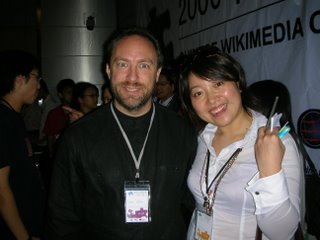
The content in the panel discussion is boring: why Chinese government blocked the wiki? everyone was guessing, while someone tried to explan from a Hong Kong perspective. Most of the speakers, except Jimmy Wales, tried to connect it to the democracy in Hong Kong, and BTW, most of them, except Jimmy Wales, are just occasional Wiki readers or never use Wiki before. The whole topic is a little out of way.... It is more important to talk on some practical topics, say, how to solve the problem, or how to make more mainland Chinese contribute. When a young college student standed up to give his idea which is to set up a version of Wiki without politics, two of the speakers even refused immediately: "You are self censorship yourself". What? at least that young student is thinking of some creative way, not even like someone just sitting there to judge others' creative idea all the time.
Anyway, Jimmy Wales is so cool. And I just like like like him. here is the photo. Am I a lucky girl to be shooted together with him?
I agree with lawrence Li (in chinese) that the conference is a little bit boring, though my job as a volunteer was really chanllenging. Could you imagine doing a real time translation for a five-person panel discussion? Everyone speak fast and love to challenge each other. More terrible, four of the five person are non-native English speakers, and it makes harder to translate other people's secondary language. I was almost crazy. Will never do it again...... just for wiki this time.....
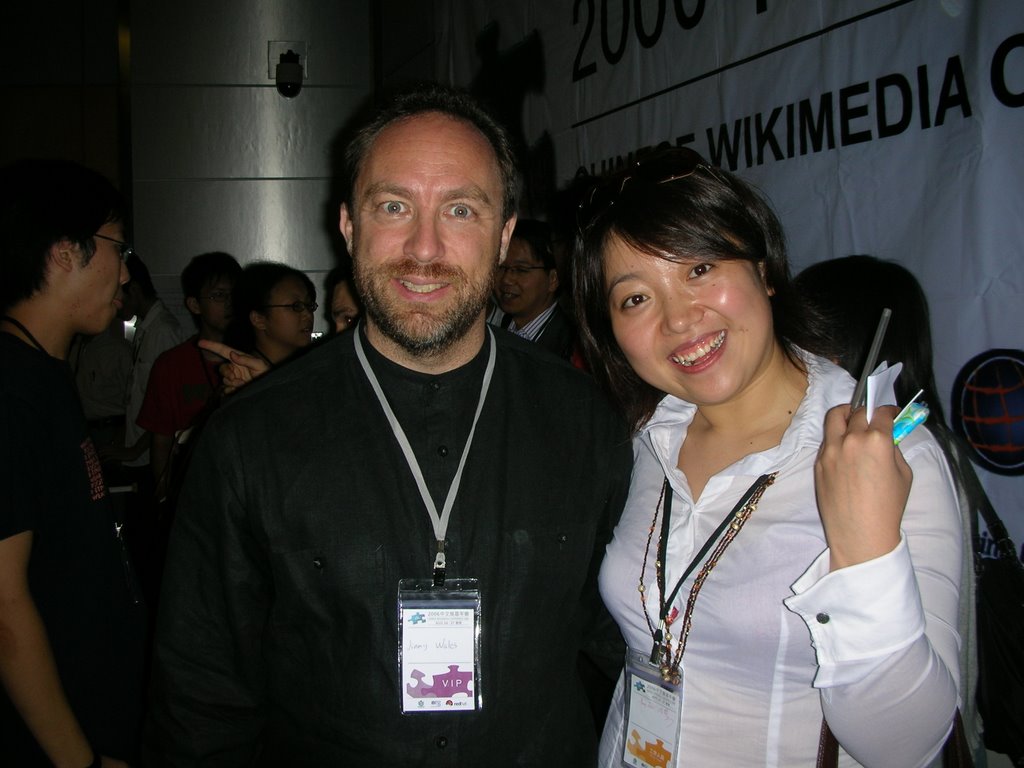
The content in the panel discussion is boring: why Chinese government blocked the wiki? everyone was guessing, while someone tried to explan from a Hong Kong perspective. Most of the speakers, except Jimmy Wales, tried to connect it to the democracy in Hong Kong, and BTW, most of them, except Jimmy Wales, are just occasional Wiki readers or never use Wiki before. The whole topic is a little out of way.... It is more important to talk on some practical topics, say, how to solve the problem, or how to make more mainland Chinese contribute. When a young college student standed up to give his idea which is to set up a version of Wiki without politics, two of the speakers even refused immediately: "You are self censorship yourself". What? at least that young student is thinking of some creative way, not even like someone just sitting there to judge others' creative idea all the time.
Anyway, Jimmy Wales is so cool. And I just like like like him. here is the photo. Am I a lucky girl to be shooted together with him?
Tuesday, August 22, 2006
google and blogger
Google.com has started to let its gmail user log on blogger.com......automatically....... Frankly speaking, I hate it. Come on, I am already the user of blogger.com and gmail.com. Now with my gmail opening, I have to log out first when i go to the blogger.com and then log in again. Troublesome.
It is not a google way. in my concept way, google should be cool, cool, cool. It just needs to attract users by excellent services such as google map, gmail, google talk and so on. But not by forcing users using the service under the same account...automatically......
Just want to say another thing but first annoyed by the above things.
An employee of baidu.com was killed by the door guard after she finished the work in the midnight. It was late then, almost the midnight, so she just slept in the company, while the door guard, a bad guard, went inside trying to rape her. However, the girl resisted hardly and then the guard killed her. (Quote from the link in Chinese)
It was not about Baidu.com, though it may be be that popular online if it is another company. but the security is just so bad, even guard will do illegal things. When economy develops quickly, people miss a lot of other things, such as ethics.
The old China has various rules on ethics; though they are old, they are still useful in maintain the peace in the society. or the society will expand too fast, just like a balloon, and finally.....booh..boo... bo....
It is not a google way. in my concept way, google should be cool, cool, cool. It just needs to attract users by excellent services such as google map, gmail, google talk and so on. But not by forcing users using the service under the same account...automatically......
Just want to say another thing but first annoyed by the above things.
An employee of baidu.com was killed by the door guard after she finished the work in the midnight. It was late then, almost the midnight, so she just slept in the company, while the door guard, a bad guard, went inside trying to rape her. However, the girl resisted hardly and then the guard killed her. (Quote from the link in Chinese)
It was not about Baidu.com, though it may be be that popular online if it is another company. but the security is just so bad, even guard will do illegal things. When economy develops quickly, people miss a lot of other things, such as ethics.
The old China has various rules on ethics; though they are old, they are still useful in maintain the peace in the society. or the society will expand too fast, just like a balloon, and finally.....booh..boo... bo....
Friday, August 18, 2006
do people care about China's capital market?
I've been writing on China's capital market in English for a while, especially in the stock market. A question remaining in the mind is if English readers do care about this market. Frankly speaking, China's market is still a domestic market, while players are all, or mostly Chinese. So why people still want to read the news in English? Do English readers care about a Chinese company buying another Chinese company, or a Chinese tycoon has been punished?
I am still on my way to find the answer. However, a lot of media have been trying to do that. Have a look at Wall Street Journal, Financial Times and even Times magazine. A lot of stories on Chinese companies. Nobody did it before, so everyone wants to be the pioneer. It's not easy, especially for reporters. They have to be familiar with both side, Chinese side and English side, to find a way to cover interesting stories.
But I still wonder if people really care. Anyone has idea?
I am still on my way to find the answer. However, a lot of media have been trying to do that. Have a look at Wall Street Journal, Financial Times and even Times magazine. A lot of stories on Chinese companies. Nobody did it before, so everyone wants to be the pioneer. It's not easy, especially for reporters. They have to be familiar with both side, Chinese side and English side, to find a way to cover interesting stories.
But I still wonder if people really care. Anyone has idea?
Saturday, August 12, 2006
Chinese Wikimedia conference 2006 in Hong Kong
Chinese Wikimedia Conference 2006 will be held in Hong Kong from August 26 to August 27. I almost missed it as I was so busy with my job these days. However, Luckily, I found it just before the conference, and thought it would be interesting to attend and volunteer there.
Wiki grows fast. I first heard about it in 2004, when it was pretty new with only a few users. Now, it is so big, covering every corner of the world. I am not sure if the Chinese bloggers are more active now, maybe not as active as in the English version. But I believe people will soon fall in love with it.
If you just drop by HK in the period, come to the conference and have fun.
Wiki grows fast. I first heard about it in 2004, when it was pretty new with only a few users. Now, it is so big, covering every corner of the world. I am not sure if the Chinese bloggers are more active now, maybe not as active as in the English version. But I believe people will soon fall in love with it.
If you just drop by HK in the period, come to the conference and have fun.
Thursday, August 03, 2006
Say something for Carlyle Group
As one of the biggest and government official-backed private equity funds in U.S., Carlyle may be already used to political pressure. But I couldn't quite understand why it faces so much hurdle in its deal in China.
I remembered cleard a classmate from U.S. once told me the nationalism among Chinese is very dangerous. I was angry to hear that at first, but then found the words had a point. In fact, as Chinese suffered a lot in the war before 1950s, they knew they have to love their nation as much as they can in order to survive. But the fact is that the country becomes bigger now, which means the nation needs to do things to strengthen herself, instead of just protecting herself. But most Chinese still hate Japan, though Japan has taught Chinese a lot of the industrilization and corporate governance. Governments, unfortunately, make use of this kind of nationalist to play on the politics.
Now, it is the same with foreign merge & acquistions in China. Government is afraid that it will lost control on the state-owned companies after selling stakes to foreign investors. So it tells people that it will do harm if foreign investors buy into the company. And then many people protest again, just like they did to the Japanese.
But people should try to investigate before making a judgement. Like Carlyle's deal to Xugong group, one of the biggest heave machine makers in China. Carlyle wants it, Xugong wants it, and even the local government wants it. Then why central government couldn't make a decion in the period as long as three months? Some competitors even said Xugong was sold cheaply. But that's not a reason, isn't it? When foreign investors first came to China in 1990s after Deng Xiaoping made the decision, they also thought China's things are cheap, the reason why they came and buy factories. Why people at that time didn't say the state-owned companies are sold cheap? More important, what Carlyle will bring will be a transparent governance system, which will be much better than a non-transparent company where a lot of bribery will happen?
I am not a Carlyle fun, but just want to make a balance when all the Chinese newspaper which blamed Carlyle all day and when Carlyle hasn't said anything. Today people even argued that Pacific Insurance, in which Carlyle bought a stake a few years before, was also sold cheap. Come on, a bread in China now is sold at least five times expensive compared with years ago, and why couldn't a company? If someone wants to sell and someone wants to buy, the deal should be made, and that's called market economy.
I remembered cleard a classmate from U.S. once told me the nationalism among Chinese is very dangerous. I was angry to hear that at first, but then found the words had a point. In fact, as Chinese suffered a lot in the war before 1950s, they knew they have to love their nation as much as they can in order to survive. But the fact is that the country becomes bigger now, which means the nation needs to do things to strengthen herself, instead of just protecting herself. But most Chinese still hate Japan, though Japan has taught Chinese a lot of the industrilization and corporate governance. Governments, unfortunately, make use of this kind of nationalist to play on the politics.
Now, it is the same with foreign merge & acquistions in China. Government is afraid that it will lost control on the state-owned companies after selling stakes to foreign investors. So it tells people that it will do harm if foreign investors buy into the company. And then many people protest again, just like they did to the Japanese.
But people should try to investigate before making a judgement. Like Carlyle's deal to Xugong group, one of the biggest heave machine makers in China. Carlyle wants it, Xugong wants it, and even the local government wants it. Then why central government couldn't make a decion in the period as long as three months? Some competitors even said Xugong was sold cheaply. But that's not a reason, isn't it? When foreign investors first came to China in 1990s after Deng Xiaoping made the decision, they also thought China's things are cheap, the reason why they came and buy factories. Why people at that time didn't say the state-owned companies are sold cheap? More important, what Carlyle will bring will be a transparent governance system, which will be much better than a non-transparent company where a lot of bribery will happen?
I am not a Carlyle fun, but just want to make a balance when all the Chinese newspaper which blamed Carlyle all day and when Carlyle hasn't said anything. Today people even argued that Pacific Insurance, in which Carlyle bought a stake a few years before, was also sold cheap. Come on, a bread in China now is sold at least five times expensive compared with years ago, and why couldn't a company? If someone wants to sell and someone wants to buy, the deal should be made, and that's called market economy.
Monday, July 31, 2006
People's Bank of China blamed a business newspaper
It is rare for a Chinese government agency to blame a Chinese newspaper. But today I saw it(the link to the central bank's statement in Chinese) The annoucement said the central bank strongly blame the July 27 report on China Business News saying China could acommodate the yuan to increase by 5 percent in a year. The paper quoted an expert saying that China may first step increase 2 percent or 3 percent, and finally make a 5 percent rise. The central bank spokeman said the paper didn't check the accurancy of the sources properly.
The last sentence is the central bank strongly condemn this non-responsible operation of the paper.
Say first, currency is always the most important or sensitive topic for the central government. I still remember some foreign reporters were jailed due to reports on currencies. This time, it is about a Shanghai-based paper belonging to Shanghai Media Group, the second-largest media corp after CCTV. Unfortunately, the paper itself didn't live well these days as the group wants to sell it, though it reported a lot of interesting stories. As the first daily business newspaper in the mainland, it lacks a strong group to back up.
Behind the currency topis, I see the different situation for official media and non-official media to live in the current time. Foreign media always call all the mainland media official ones; in fact, it isn't true. For some of them such as China Business News and 21st century Herald, they are living on themselves, depending on good stories instead of government ties to survive. It is hard in terms of both revenue and reputation. Say how Central bank blames China Business News, you will know the difference. But it is those papers or media trying to bring fair business environment in China. Free media will help setting up a fair, transparent and stable securities market. Have a look at Hong Kong where media is free to say everything. It is hard to try in the current Chinese market, but someone trying now will become the hero.
The last sentence is the central bank strongly condemn this non-responsible operation of the paper.
Say first, currency is always the most important or sensitive topic for the central government. I still remember some foreign reporters were jailed due to reports on currencies. This time, it is about a Shanghai-based paper belonging to Shanghai Media Group, the second-largest media corp after CCTV. Unfortunately, the paper itself didn't live well these days as the group wants to sell it, though it reported a lot of interesting stories. As the first daily business newspaper in the mainland, it lacks a strong group to back up.
Behind the currency topis, I see the different situation for official media and non-official media to live in the current time. Foreign media always call all the mainland media official ones; in fact, it isn't true. For some of them such as China Business News and 21st century Herald, they are living on themselves, depending on good stories instead of government ties to survive. It is hard in terms of both revenue and reputation. Say how Central bank blames China Business News, you will know the difference. But it is those papers or media trying to bring fair business environment in China. Free media will help setting up a fair, transparent and stable securities market. Have a look at Hong Kong where media is free to say everything. It is hard to try in the current Chinese market, but someone trying now will become the hero.
Subscribe to:
Posts (Atom)
